
Claddagh
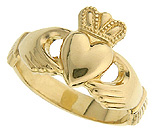
Claddagh itself refers to a small fishing village just near Galway city. The Claddagh ring supposedly originated in this area. The ring has a design of a heart being encircled by a pair of delicate hands with a crown above the heart. In earlier times this design was the symbol of the “Fishing Kings of Claddagh” meaning ‘in love and friendship let us reign’. The village was called Cladach or Claddagh, this means “Stony Foreshore of the beautiful Galway Bay”. The origin of the ring hold a long and complicated tale. Visit the City Museum for more on the claddagh.
Lynch’s Castle
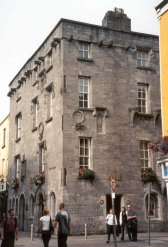
Lynch’s Castle was the historic home of Galway’s most powerful family. A magnificent limestone building, it is an excellent example of the Irish Gothic style. Its heavily carved facade bears the arms of Henry VIII. Standing on the corner of Shop Street and Abbeygate Street, Lynch’s Castle gives us a rare glimpse of old Galway. The 1651 Pictorial Map of the city shows fourteen lavish merchant homes. Lynch’s Castle alone survives intact. Today it houses the AIB bank.
Galway Cathedral
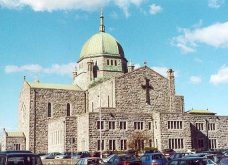
Galway’s Catholic Cathedral is one of the largest and most impressive buildings in the city. Built between 1958 and 1965, it stands on the site of the old city jail. The architecture of the Cathedral draws on many influences. The dome and pillars reflect a Renaissance style. Other features, including the rose windows and mosaics, echo the broad tradition of Christian art. The Cathedral dome, at a height of 145 ft, is a prominent landmark on the city skyline.
Spanish Arch

Spanish Arch is one of Galway’s most historic landmarks and consists of 2 stout arches. Synonymous with Galway, the Spanish Arch stands on the left bank of the Corrib, where Galway’s river meets the sea. The arch is the remainder of a 16th century bastion, added to the town’s walls to protect merchant ships from looting. At this time, it was known as Ceann an Bhalla (Head of the Wall).
St Nicholas’ Church
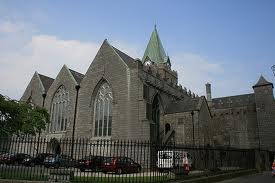
Church is one of the oldest parish churches in Ireland. It has been a place of worship since the 14th Century. In common with many mediaeval ports, Galway dedicated its church to the patron saint of sailors. According to recent research, Columbus visited St. Nicholas’ in 1477. Today, St. Nicholas’ is still at the heart of the city’s activities. The main Galway market is held every Saturday outside its gates.